This list is invented to make some quick and easy blogs for this month filled with festivities. I chose these specific buildings because i think they belong to the most important from all buildings realized in the last 100 years.
So here is no.6. the Villa Savoye by Le Corbusier
Villa Savoye
No…., this is not a contemporary house, but one of the first buildings finished in 1931 where Le Corbusier tried to invent a new architecture.
The five points of a new architecture. Formulated by Le Corbusier in 1927 as the fundamental principles of the Modern movement, the five points advocate reinforced concrete for constructing the pilotis, roof garden, open plan design, horizontal windows and free design of the façade – all applied in the design of the Villa Savoye.
The architect. Swiss-born, Charles-Édouard Jeanneret (1887-1965), known as Le Corbusier, was part of the Parisian avant-garde. He was a founding member of the International Congress on Modern Architecture (or CIAM), launched in 1928. The Villa is now a museum and can be visited.
I specially went to Bottrop to see the Nixon series on the Brown sisters in 2004 and i was not disappointed ( poster available at www.ftn-books.com).
Nicholas Nixon takes intimate, black-and-white photographs of children, the elderly and infirm, and his own family (as well as cityscapes). Best known for his series “The Brown Sisters”, Nixon began taking portraits of his wife, Bebe, and her three sisters in 1975, and has continued to photograph them annually since.
left the Brown Sisters in 1980 , right the Sisters in 2019
Influenced by the photography of Walker Evans, Edward Weston, and Alfred Stieglitz, among others, Nixon works with a large-format camera; “For me the print is what matters most. Generally the biggest possible negative has the most clarity, presence, and believability,” he has said. Nixon’s images, which include close-up self-portraits of the artist’s bearded face, manifest the humanistic potential of photography, offering moments of tenderness between individuals, and meticulously capturing the minute details of his subjects.
This list is invented to make some quick and easy blogs for this month filled with festivities. I chose the buildings because i think they belong to the most important from all buildings realized in the last 100 years.
So here is no.7. the ISOKON building
Isokon Flats, also known as Lawn Road Flats and the Isokon building, on Lawn Road in the Belsize Park district of the London Borough of Camden, is a reinforced concrete block of 36 flats (originally 32), designed by Canadian engineer Wells Coates for Molly and Jack Pritchard
Just look at the picture and try to realize that these apartments were designed over 80 years ago….. a true classic
www.ftn-books.com has many titles availabel on classic and modern architecture
Kurt Kocherscheidt was born on the 6th of July 1943 in Klagenfurt, Austria to Friedrich and Elisabeth Mayer. After the divorce of his parents in 1946 and the move of his father back to Germany, the most formative person in his youth became his grandfather August Mayer (1885–1958) whose deep friendship with Hugo Adolf Bernatzik, a famous ethnographer and explorer, awakened Kocherscheidt’s interest in geography, zoology and art in general.
In 1961, after completion of his school years in Klagenfurt and Friesach (his mother’s hometown), Kocherscheidt moved to Vienna to study painting at the Academy of Fine Arts under Professor Sergius Pauser. As a way of supplementing his income, during the summers he would restore gothic frescos, in his words: “the thought of financial stability” led him to move to Zagreb (then Yugoslavia, now Croatia) for two years (1963–1964) to study mural painting under professor Ivo Rezek at the Akademija Likovnih Umjetnosti, before returning to Vienna and completing his academic studies in 1965. In 1967 he married and divorced his long-time partner Andjelka Feuer.
In 1968 Kocherscheidt became a founding member of the artist group “Wirklichkeiten” (Realities). At a moment when the prevailing trend in art leaned towards conceptual art, these artists were bound by their interest in traditional modes of production, such as painting and drawing, and the representational qualities they favored. During this period, Kocherscheidt was predominantly painting highly saturated imagined landscapes that included both homages to real horticulture and surreal futuristic elements rendered in a palette that recalled the Fauves. The group included several painters who were of his generation and active in Vienna at the time, including: Wolfgang Herzig, Franz Ringel, Robert Zeppel-Sperl, Martha Jungwirth (who joined in 1969), and Peter Pongratz. The Kocherscheidt exhibition pposter for the JOsef Albersmuseum is now available at www.ftn-books.com
This list is invented to make some quick and easy blogs for this month filled with festivities. I chose the buildings because i think they belong to the most important from all buildings realized in the last 100 years.
So here is no. 9. the Cité Radieuse by Le Corbusier
This big appartments building in Marseille was a source of Inspiration voor many apartment buildings that were realized after this was finished. The outside colors are inspired by BAUHAUS and executed in a special concrete paint in primary colors. The buidling is build from 100% armored concrete and includes 337 separate apartments. A community palyground was specially made for the occupants of these apartments. Since 2016 it belongs to the World Heritage list of Unesco
www.ftn-books.com has some nice publications on Le Corbusier
This list is invented to make some quick and easy blogs for this month filled with festivities. I chose the buildings because i think they belong to the most important from all buildings realized in the last 100 years.
So here is no. 10 by Mies van der Rohe. It is the National Museum in Berlin. Not only a very nice building but also one of the most important collections in the world. The Kandinsky’s and the Kirchner paintings are one of a kind and i always will remember them.
Just look at this building for more than a few seconds and be amzed by its beauty. Even teh Calder in front is impressive.
www.ftn-books.com has some nice publication from the Nationalgalerie and on Mies von der Rohe
This is a rare occxasion that i can offer two of the most iconic and early Keith Haring catalogues ever published. I have bought recently these two catalogue from a duthc collector and now i am offering these at www.ftn-books.com.
The CAPC catalogue is even more exceptional than the Stedelijk Museum catalogue . The CAPC has a silkscreened baby on the dustcover. These are highly collectable books and the true Haring collector will know that this is a a rare opportunity to acquire these for his or her collection.
In the late fifties of the past century Maja van Hall studied classical sculpture at the Rijksakademie van beeldende kunsten (State Academy of Fine Arts) in Amsterdam, a solid basis for which she remains grateful to this day. For the content of her work she has developed a vocabulary of her own, which she feeds with her own experience of life. She uses the expressive potential of stone, clay, bronze and sometimes wood to give form to her own state of mind. Slowly but surely, she is gaining more and more freedom for herself and for her sculptures.
In the sixties she opted for a more informal, abstract expression in material and gesture. She never entirely foreswore figuration, though, preferring the form to emerge from her subjects. Take the small bronze of a vacuum-cleaning female she made in 1967 with the derogatory title of ‘Sloof’ (‘Drudge’). As a feminist, Maja van Hall had created a little monument to the housewife. Three decades later this small sculpture will appear as a huge blue monument (‘Filosloof‘) during the international exhibition ‘Role Models’, The Hague Sculpture 2003. A polyester version was acquired in 2009 by the Museum of Modern Art in Arnhem in the aftermath of the international exhibition ‘REBELLE. Art and Feminism 1969 – 2009.
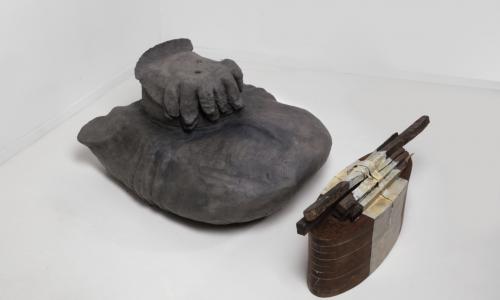
In 1968, in an abstract-expressive vein, she represented the concept of ‘Battle’ in an eponymous bronze as the aggressive confrontation of two ‘parties’ in form and counterform, light and dark, line and plane, open and closed. While she is working on a piece it takes on colour for her, sometimes quite literally when she treats it with pigments and the colour actually defines the sculpture. Such is the case with ‘Blue Dog’ (1988). Aggressive, as if it had escaped from a myth, there it stands, as large as life. In her recent installations she may also add planes of colour – pure pigment on paper – to emphasize the theatrical character of the spot and the spatial unity of the whole piece. ‘Thoughts’ (1992), which she modelled in plaster but also had cast in bronze, seems to have been worked on for so long that the form is worn away and the surface weathered, as if from centuries of use or misuse. The form of a human head can be discerned. It rests on a satin pillow. This is Maja van Hall’s comment on the aesthetic perfection of Brancusi’s work, except that in spite of – or thanks to – the destructive erosion, she has rendered visible and tangible the victory of human strength. Using her personal experience as a source of creativity, she has built up a consistent oeuvre that pays scant heed to trends. She has given her personal emotions, emotions we all feel, a place and look of their own in Dutch sculpture.
Relations between people, shifts in world cultures and changes in the technological, architectural, natural and human domain are sources inspiration for me. They are all images and spheres that exist, both dependent and independent from each other.
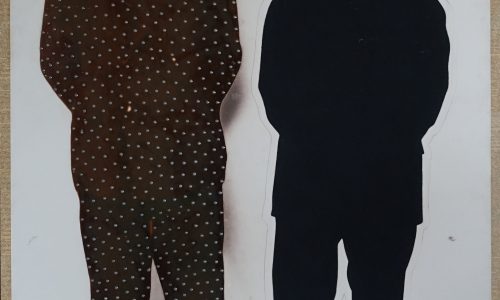
Central in my sculptures is the human image: the human not as an individual, but as an universal figure. In my work I represent the time relatedness and the different levels of human behavior by using transparency. For instance in the sculptures ‘Silhouetten’ and ’52 Dialogen’ the corten steel is cut through with human figures. This produces special views, with many perspectives and represents vulnerability, captured in the hardness of steel.
As a painter I express this complexity, these different levels, by working with transparent layers and sometimes mixing them. The colors and the forms that I use in my works have a special meaning, a symbolic value and are a determining factoring in the composition. The titles that I give to my works are connected with this inspiration or with a recognition of my emotional or other experiences. These layered compositions, connected to different elements of the image, give rise to multiple meanings and interpretations of my themes. They symbolize a fracture of time: for me time is an unending chain of events, without beginning or end, a cycle.
I have always been inspired by music, dance and literature. Travelling is another important starting point for my work. When I am in another county I am interested in the local cultures and in what motivates human behavior. When I was in New York I made a lot of paintings on the theme human-city. My stay gave me also a lot inspiration for new work that I completed in my studio in Holland. My journeys to South-America and Egypt provided me with completely different images, new impressions and new visions that I explored further in my studio. In 2010 I got the opportunity to work in Italy, in a guest studio as ‘artist in residence’. In Italy paintings on the theme human-nature came into being: a number of them you can see in this catalogue.
My working method comprises many techniques in different materials: paintings, mixed techniques on paper/collages, silk screen printings, sculptures in corten steal, ceramic objects.
Just a simple blog on a great artist and his ideas . I admire Martijn Sandberg for his art. Every few month i look at his site and find some new works that fascinate me . Just take a dive into Martijn’s ideas and visit the link below. An internet related project by Martijn Sandberg. An art work he exclusively made available on the internet
Martijn Sandberg ‘Image Messages’The work of Amsterdam based visual artist Martijn Sandberg (1967) constantly explores border areas, such as the tension between text and image, illegible into legible, the private and the public domain. ”I make Image Messages, image is message is image.” The image hides the message. In the cut paintings, such as ‘Sorry No Image Yet’ and ‘Im Westen Nichts Neues’, there is a subtle play between the language of the image and the significance of the image, and this gives rise to questions. Here, even the lack of image seems to be elevated to an image by the artist.
The direct relationship between the image, the material bearing the image and the environment is also expressed in his site-specific works in public space and architecture. As in the ‘De Oude Weg Naar De Nieuwe Tijd’ artwork, integrated as a brick relief in the walls of the gates and the pavement of the Spaarndammerhart building, Amsterdam. Or in the sculpture ‘I Will Survive’ located at the border of a burial ground in Hardenberg, The Netherlands.
BTW. For those interested in the editions by Martijn Sandberg please visit his shop at :
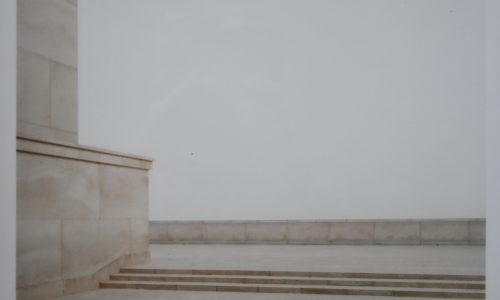
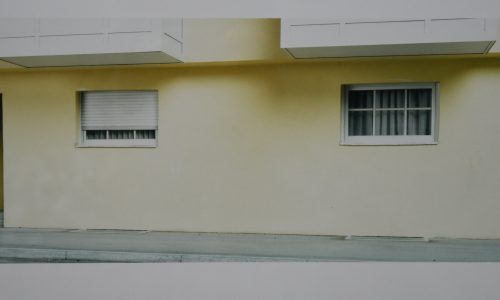
Artist/ Author: Oliver Boberg
Title : Memorial
Publisher: Oliver Boberg
Measurements: Frame measures 51 x 42 cm. original C print is 35 x 25 cm.
Condition: mint
signed by Oliver Boberg in pen and numbered 14/20 from an edition of 20